
How Elite Event Planners Decode Unspoken Expectations & Create Successful Company Gatherings
Let’s talk about how to plan THE event. The one people keep on talking about years later. (And not because someone did something embarrassing, but because it hit all the must-dos and set the stage for some serious business growth.)
Step 1 is to remember that events aren’t one-size-fits-all. You can’t treat them like it. To make each event successful, you need to plug into the event’s specific cultural, political, and psychological dynamics.
Kelley Thompson, our head of growth, has created a strategic framework that helps you understand what stakeholders are really asking for, find hidden success metrics, and design experiences that go above and beyond.
Perfect logistics, but the wrong direction
People are all-in on having the best-laid logistics – but that ignores the human and cultural pieces of the puzzle, which actually drive business outcomes.
"What's the measurement of success for your event?" Kelley asks. "Is it that you get people together? Is it networking opportunities? Is it 10 sponsors?" Talk to 100 event planners, and you'll get 50 different answers.
Sometimes, Kelley says, stakeholders have event expectations they can’t really explain. You have to mastermind what they’re really looking for and what they want to solve.
Planners who just check off a list of requirements – headcount, budget, space – without considering business goals and cultural context are making functional decisions that miss the bigger picture.
The result? Events that meet specs but don't hit business objectives. And when those hidden expectations surface, planners get slammed with last-minute changes and scope creep.
The framework you need
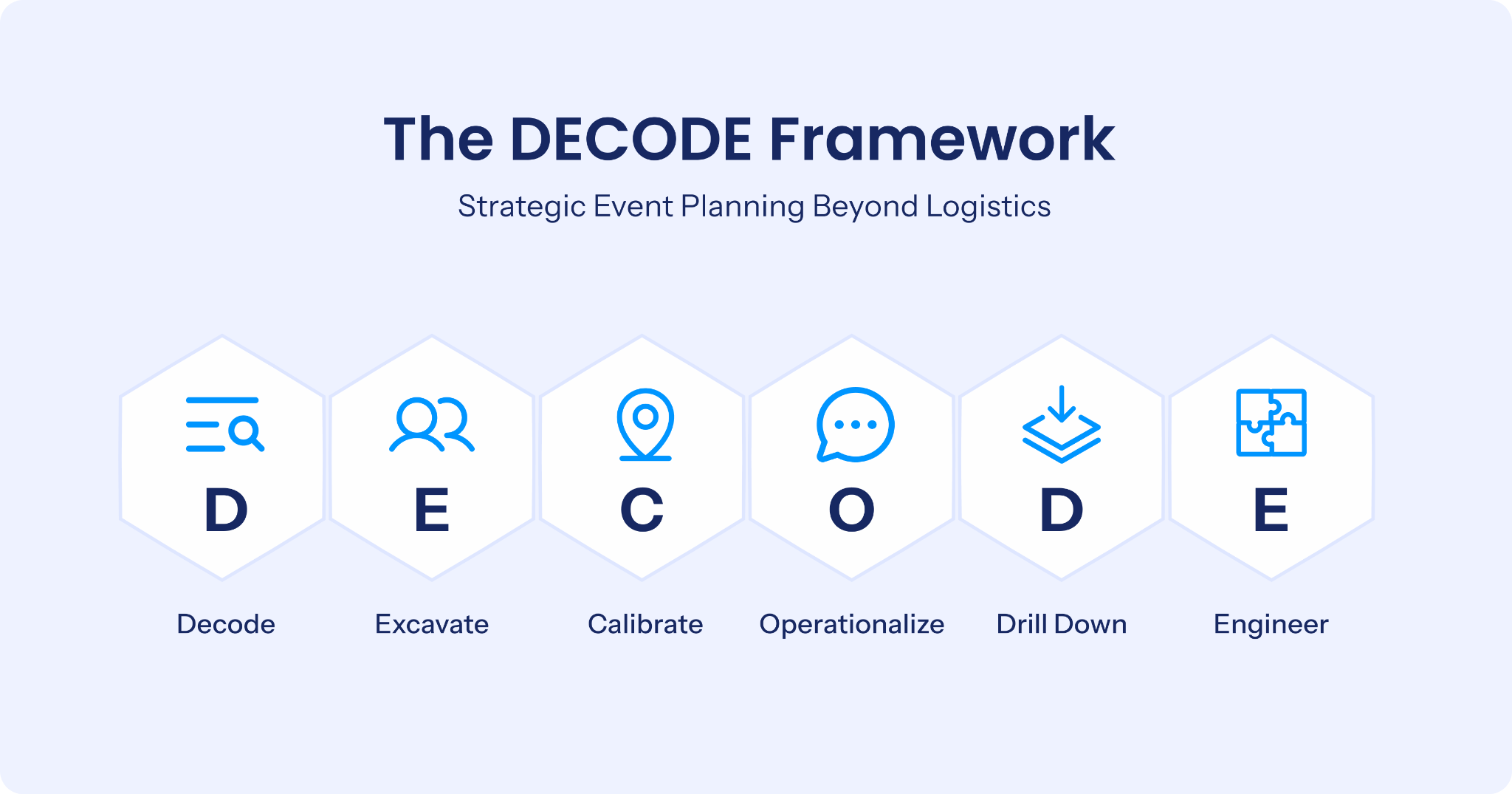
You can avoid missing the mark on expectations with Kelley’s DECODE framework. It transforms standard, rigid event prep into strategic planning that aligns every gathering with your organizational DNA and has measurable business outcomes.
D - DECODE ORGANIZATIONAL DNA
Basically: who really needs to be happy for this event to be considered successful? If you’re trying to make everyone happy, but really, the CEO’s experience matters the most, you’re dropping the ball.
Success often relies on satisfying one person (or a few select people). Your goal should be to figure out the real stakeholders and influencers of the event, as well as the power structures and cultural values that need to drive your decision-making.
E - EXCAVATE AUDIENCE NUANCES
What tone and energy is right for these specific attendees? The name of the game is customization. Take time to look into the backgrounds, seniority levels, and expectations of your entire guest list.
With that info in hand, you can think about how formal or informal the affair should be, and fill in any needs or preferences for different groups or even people from different regions.
C - CALIBRATE THE VENUE TO CULTURE
Your venue and atmosphere should fit your audience’s nuances and your organizational personality, not just generic "best practices." A tech bro gathering with Nerf guns would feel out of place at a Westin, for example. You want the location and venue choice to reflect who your organization is and support your goals.
You should also think about how the location will make your attendees feel, and tie in business objectives to the atmosphere itself.
O - OPERATIONALIZE EXPECTATION ALIGNMENT
Get ahead of any issues by keeping communication early, honest, and clear. That’ll keep conflicts and misaligned expectations at bay. Part of that is pushing stakeholders to define vague expectations ("atmosphere," "vibe," "energy") and articulate what success looks like in specific, measurable terms.
Iron out everything, from non-negotiables to nice-to-haves. And keep that list on hand as you plan. Kelley’s seen a lot of companies sign a hotel or venue contract only to realize, “Oh no! The CEO wants to be in the Financial District!”
D - DRILL DOWN
Find out what problem this gathering wants to solve. Don’t take an answer that’s too surface level OR too high level and just run with it.
“Go 3 layers deep,” Kelley advises. “Ask, ‘What do you mean by that? Just explain it to me like I'm 10.’” Once you find out the real needs and constraints of the event, don’t be afraid to push back on what the event “should” look like. Assumptions can prevent you from hitting your goals.
E - ENGINEER FOR CULTURAL COHESION
Every element of your event should reinforce organizational culture and business goals. That means your experiences should be designed to do both. You can bring up company values through a game of mini golf, for example, and support business goals with a collaborative in-person project.
With careful planning, you can build in moments that celebrate your company identity, whether that feels like a happy hour, a walking tour, or a boat ride.
Strategic principles for excellent event planning
Master the art of strategic listening
"You have to be really good at understanding somebody else's problem better than they do," Kelley says. That’s because sometimes the most important information is hiding behind what stakeholders don't say. You need to develop that skill, interpreting context clues and any dynamics or hierarchies.
Design for the decision maker first
A small number of stakeholders can make or break event success – that’s who you need to be thinking about when you start planning. Then you can think about the attendees and balance their interests too.
Match venue personality to organizational culture
Design for the decision maker, but consider the audience too! Messaging matters – your location should jive with your company culture and the event aims, not clash.
Make vague requirements actionable
Keep asking, "What does that mean?” Don’t let higher-ups coast on adjectives like “vibey” – dig until you know how to hit that mark. That way, an abstract idea becomes an experience you can actually deliver on.
Build consensus before commitment
Don’t sign anything until you’re sure that everyone’s on the same page. Block out time to align with the important stakeholders early so you don’t have to deal with expensive changes or any relationship breakdowns later.
Successful event planning isn't about perfect logistics. It's about understanding the deeper organizational dynamics and cultural context at play. When you identify key stakeholders, look at audience nuances, and align every decision you make with your company culture and goals, you can move beyond checking boxes – you can create experiences with lasting impact and measurable outcomes.
For a step-by-step guide to sending the best hotel RFPs, check out Kelley’s tactical guide.
Written by
Garrett Ullom